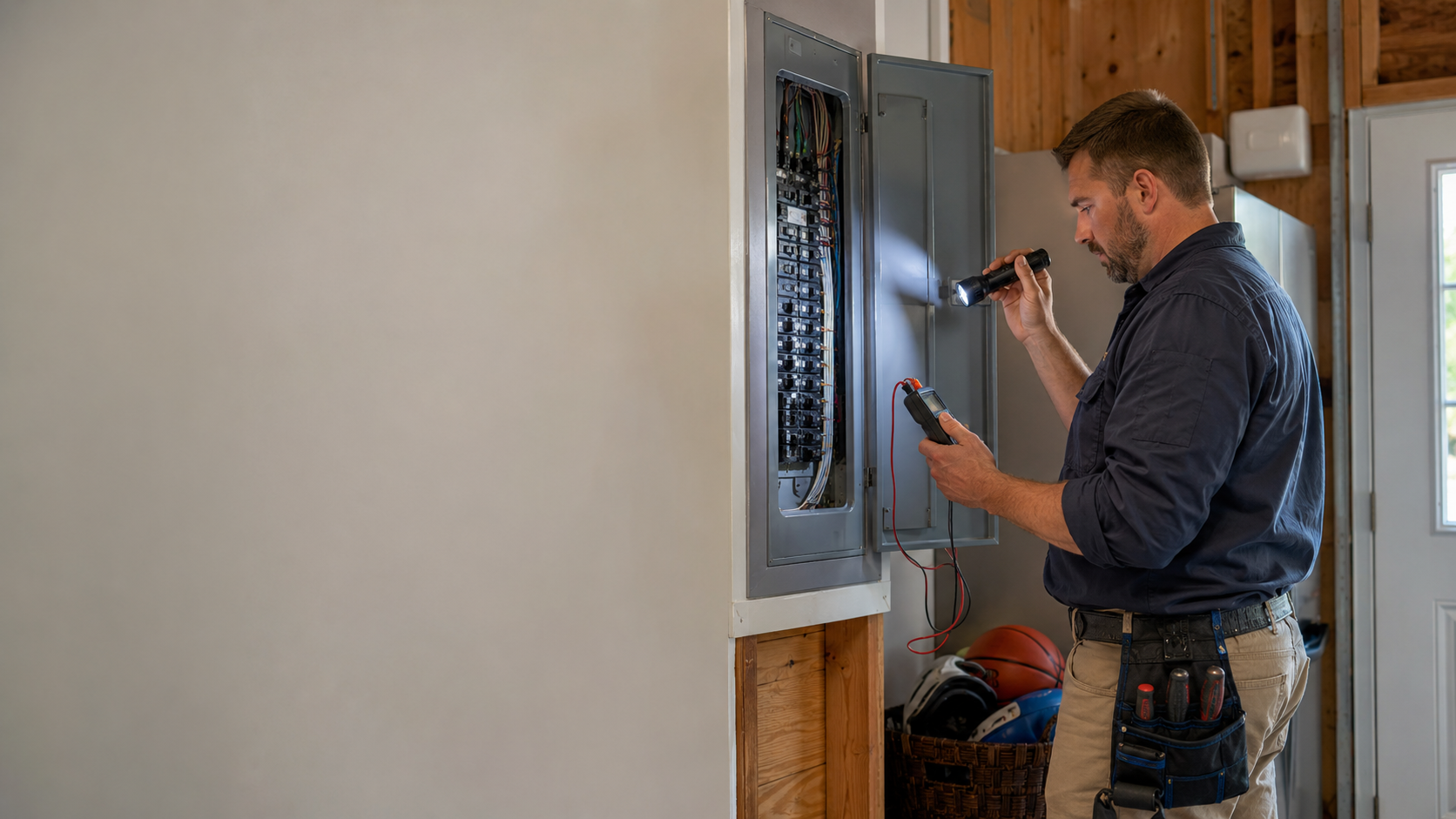
A breaker that trips is doing the job it was built to do. It cuts power before a circuit carries more current than its wiring can safely handle. So the question worth answering is not how to make the tripping stop. It is where the cause sits: on one branch circuit, or in the panel that feeds all of them.
Those two answers lead to completely different work. You can gather most of what an electrician needs without ever removing the panel cover, and the observations below are the ones that matter.
What the trip is telling you
Breakers open for two broad reasons. One is overload, where a circuit is asked to carry more current than the breaker is rated to pass, usually because too many things are running on it at once. The other is a fault, where current finds a path it was never meant to take, either between conductors or to ground.
The two behave differently, and the difference is easy to observe. An overload builds. You start the microwave while the toaster is running, and the breaker gives out a few seconds later. A fault is immediate. You reset the breaker and it snaps back off right away, sometimes before you have let go of the handle.
Note which one you are seeing. It is the single most useful thing you can hand to an electrician.
Signs the problem lives on one circuit
A circuit-level issue is usually well behaved, in the sense that it is predictable. The same breaker trips. It trips when a particular appliance runs or when a particular room is busy. Leave that appliance off and the breaker holds for weeks.
The Electrical Safety Foundation International lists the warning signs of an overloaded electrical system as:
- Frequent tripping of circuit breakers or blowing of fuses
- Dimming of lights when other devices are turned on
- Buzzing sound from switches or outlets
- Discolored outlets
- Appliances that seem underpowered
Read that list with one circuit in mind rather than the whole house. If the lights dim only in the back bedroom when the window unit kicks on, you are looking at one circuit carrying too much. If they dim everywhere, keep reading.
A simple way to confirm it
- Before you reset anything, write down what was running and in which rooms.
- Turn off or unplug the high-draw items on that circuit. Space heaters, window air conditioners, hair dryers, microwaves and portable cooktops are the usual suspects.
- Reset the breaker and bring items back one at a time, leaving a few minutes between each.
- When it trips again, you have found either the appliance or the combination that pushes the circuit past its limit.
- Move one of those items to an outlet on a different circuit and see whether the trips stop.
If relocating a single appliance solves it, the wiring is not necessarily faulty. The circuit is simply carrying more than it was laid out for, and the durable fix is usually a dedicated circuit for that appliance rather than anything at the panel. ESFI gives the same advice: have a qualified electrician install new circuits for high-energy use devices.
When it trips the instant you reset it
Stop the redistribution testing. A breaker that will not stay on with everything unplugged is not reporting an overload. Something is wrong on that circuit itself, whether that is a damaged cable, a failing appliance, moisture in an outdoor box or a loose connection inside a device. Repeated resetting does not clear it and does not tell you anything new.
The same logic applies to a ground fault interrupter that keeps cutting out. A GFCI is designed to open when it senses current leaking out of the intended path, so a persistent trip is a report, not a nuisance to be reset away. If the symptom follows a whole room or an older section of the house rather than one device, it may be a wiring problem rather than a load problem.
Signs the problem is at the panel
Panel-level problems are messier. They do not respect the neat boundary of a single circuit, and they show up as patterns rather than one repeatable trip.
- Different breakers trip at different times, with no shared appliance and no obvious pattern.
- The main breaker trips, killing the whole house rather than one room.
- Lights across the house dim or flicker when the air conditioner, well pump or dryer starts, not just in one room.
- A breaker feels warm through the panel cover, or the cover itself is warm or discolored.
- You hear buzzing, humming or crackling coming from the panel.
- A breaker sits loose in its slot, or the handle feels mushy and does not click firmly into position.
- Every slot is occupied, tandem breakers are doubled into positions, and there is nowhere to add a circuit.
- There is a burning smell, or scorch marks around the panel or on a breaker.
The last two entries are different in kind from the rest. A full panel is a capacity conversation you can have on your own schedule. A burning smell is not a conversation at all, and the section below explains why.
Age matters here too. Plenty of homes around Birmingham were wired for a household with one television, no central air and nothing charging overnight. ESFI advises having a home inspected by a qualified electrician if it is older than 40 years or has had a major appliance installed. That advice covers a large share of Alabama housing stock.
If several of the panel-level signs match your situation, an inspection rather than a single repair is often the more useful starting point, because it looks at the service as a whole instead of chasing one breaker. It is also worth reading what a panel evaluation involves before you talk to anyone, so the vocabulary is familiar when you do.
Patterns that get misread
A few situations look alarming and usually are not what people assume.
The whole house is dark. Before you blame the panel, check whether the neighbors have power and whether the main breaker handle is in the off position. A utility outage and a tripped main look identical from inside the house.
Roughly half the house is dead. Some lights and outlets work, others do not, and the pattern does not follow any one circuit. Report this exactly as you observed it instead of troubleshooting further. It can involve the conductors feeding the panel rather than anything happening inside it.
Everything works, but the lights flicker constantly. Flicker without tripping still deserves attention, because it can come from a loose connection anywhere between the utility drop and the fixture, and loose connections generate heat. When flicker arrives alongside other symptoms, the signs that point at the wiring itself are worth reviewing.
When to stop troubleshooting
Some symptoms end the observation phase. Do not remove the panel cover, do not keep resetting, and do not keep the circuit in service if you see any of these:
- A burning or hot-plastic smell near the panel, an outlet or a switch
- Scorch marks, melted plastic or discoloration on a breaker, outlet or panel cover
- A panel cover or breaker that is warm or hot to the touch
- Sparks, arcing sounds or visible smoke
- A shock or tingle from an appliance, a faucet or a switch plate
- Water inside or near the panel, or a panel that has been wet
- A breaker that trips immediately every time, with nothing plugged in
If there is smoke or an active burning smell, treat it as a fire call rather than a service call. Otherwise, switch off the affected circuit from the front of the panel if you can do so safely, leave it off, and get an electrician involved.
What to have ready before you describe the problem
- Which breaker trips, and what its label says, if the panel is labeled at all
- Whether it trips instantly on reset or after a delay
- What was running each time it happened
- How long it has been going on, and whether it is getting worse
- The rough age of the house, and whether the panel has ever been replaced
- A photo of the panel with the cover on, showing the breaker layout and any labeling
Two habits are worth keeping regardless of who ends up doing the work. Label the breakers once somebody has the panel open, which ESFI recommends as a basic safety step. And ask any provider you speak with to confirm their licensing and insurance, and to put the scope of work in writing before anything starts.
Questions people actually ask
Is it bad to keep resetting a breaker?
Resetting once to see whether the trip repeats is reasonable. Resetting the same breaker over and over is not, because you are overriding the one device telling you something is wrong. If it trips twice for the same reason, look for the cause instead.
Does a tripping breaker mean I need a panel upgrade?
Not on its own. A single circuit that trips under a predictable load usually points at that circuit, not at the service. A panel upgrade enters the conversation when the panel is out of space, when the whole house dims under load, when the main trips, or when the equipment shows heat damage. Searches for an electrical panel upgrade or a breaker panel replacement in Birmingham often begin with one nagging breaker, and the answer frequently turns out to be smaller than expected.
Can I just put in a bigger breaker?
No. A breaker is matched to the wire it protects. Fitting a higher-rated breaker does not add capacity to the circuit, it removes the protection that keeps the wiring from overheating. Breaker sizing belongs with someone who can verify what is behind the wall.
Why does it only trip in summer?
Because the load changes with the season. Air conditioning, dehumidifiers and pool equipment can push a circuit that was comfortable in March past its limit in July. Seasonal tripping is one of the clearer indications of an overload rather than a fault.
Checking what is available near you
This site is a connection service. It does not perform electrical work and has no technicians. What it does is route requests toward participating providers through service-area matching.
If you want to find out what is available for your address, call (844) 958-2599 and describe what the breaker is doing, using the notes above. Availability varies. If a participating provider can assist, they may contact you directly, and you decide whether to move forward. You can also read more about panel-related requests or how repair requests work here first.
Leave a Reply